Every integration platform hits the same wall
They all assume someone, a human or an AI, has to hand-map fields between systems, one customer at a time. That assumption is the ceiling. Here’s what it costs you.
Built from the ground up. Not assembled from acquisitions.
The enterprise iPaaS market has consolidated aggressively. Vendors acquire capabilities instead of building them: an API management tool here, a data quality product there, an RPA engine bolted on top. The result is platforms that look comprehensive on a feature checklist but operate as loosely coupled products underneath.
Built on a canonical business language
The OneEnterprise Specification (OES) defines canonical business messages (Customer, Order, Product, Invoice, Shipment, and dozens more) once, precisely. Every Business Connector maps to and from OES. Every AI agent speaks OES. Every system translates through OES. The mapping problem disappears at the architecture level.
OES is built from the team’s hundreds of prior enterprise deployments across SAP, Salesforce, Microsoft Dynamics 365, Shopify, and more. It encodes how practitioners actually work. Not academic theory, but production-tested business logic. When your AI agent asks for “open orders for this customer,” OES is the vocabulary that makes that question answerable across every connected system, instantly.

Three pillars. No other platform has all three.
Each pillar solves a distinct problem. Together, they give AI a governed, canonical path into your enterprise systems and give your team an integration platform that scales linearly, not exponentially.
Connect once, communicate with everything
Every system connects to OES through one Business Connector. From that moment, it communicates with every other system in the network immediately. Adding system number 21 doesn’t touch the 20 already connected. Complexity grows linearly, not exponentially.
From source to destination in five steps
Every integration follows the same pattern, regardless of which systems are involved or when they were added.
Source
System
Data changes in any connected system

Business Connector
Translates native format to canonical OES
OES
Processing
Key mapping, validation, routing
Business Connector
Translates OES to target native format
Target
System
Data arrives, verified and complete
Instead of translating between every pair of system dialects, everyone translates to and from one shared vocabulary. This is why integration complexity grows as N, not N².
Six capabilities built into the architecture
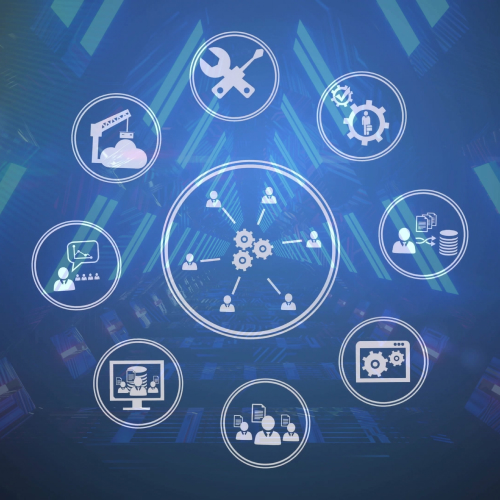
Every capability runs natively on the OES foundation. One platform, one consistent model. No acquired modules bolted together.

The same platform powers four levels of AI readiness
Every level runs on the OES foundation. Start with governed access today; climb toward conversation-driven orchestration as your AI maturity grows. Same platform, same connectors, same vocabulary. Different entry points for different roles.