
Integration complexity grows exponentially.
Unless you standardize the language.
Traditional integration works like hiring a translator for every pair of languages. Five systems? Ten translators. Add a sixth? Five more. OneEnterprise works like a single interpreter booth: every system speaks OES, so adding a new one means one new connection, not a web of new translations.
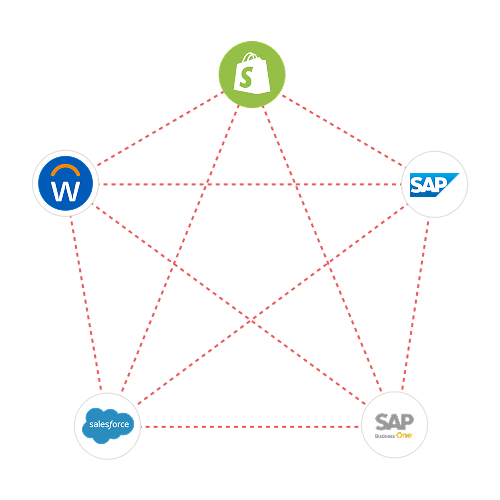

From complex to simple
Built for scale.
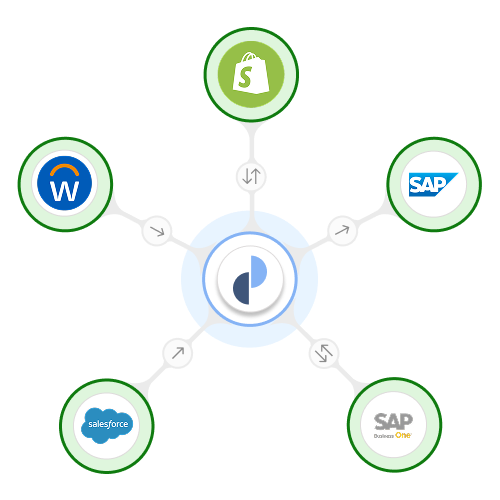
These aren’t features. They’re architecture.
Features get copied. Architecture doesn’t. Scroll through the seven structural decisions that make OneEnterprise fundamentally different.

Every MCP platform gives AI access. Then they hit a wall.
Without a canonical business language, AI can connect to your systems but cannot reason across them. It reads raw API payloads, not business objects. It cannot monitor operations or configure integration in terms your team understands. OES is the vocabulary that breaks through that wall. Four levels of AI readiness, one platform: Access, Translate, Operate, Orchestrate.
Without a canonical business language, AI can connect to your systems but cannot reason across them. It reads raw API payloads, not business objects. It cannot monitor operations or configure integration in terms your team understands. OES is the vocabulary that breaks through that wall. Four levels of AI readiness, one platform: Access, Translate, Operate, Orchestrate.

See everything. Fix anything. Without developer escalation.
Architecture is invisible until something breaks. OneEnterprise gives your operations team a shared lens into every business object, every transaction, every error, in terms they already understand.
How OneEnterprise compares.
A structural comparison with traditional integration platforms.
| Capability | Traditional iPaaS | OneEnterprise Built different |
|---|---|---|
| Data Model | Traditional iPaaSPer-connector, per-customer | OneEnterpriseCanonical OES objects shared across all systems |
| New System Onboarding | Traditional iPaaSWeeks of custom mapping | OneEnterpriseOne Business Connector, pre-mapped to OES |
| AI Readiness | Traditional iPaaSSystem-specific API payloads, no semantic layer | OneEnterpriseFour-level AI ladder: Access through Orchestrate |
| MCP Integration | Traditional iPaaSStandard MCP (system-specific context) | OneEnterpriseOES-MCP: canonical business objects as governed MCP tools |
| Sync Architecture | Traditional iPaaSAutomation triggers (one-way) | OneEnterpriseDual engine: Automation + Business Engine (bidirectional pub/sub) |
| Data Integrity | Traditional iPaaSBest-effort, retry on fail | OneEnterprisePrerequisite checks, park queue, patented key mapping |
| Cost Scaling | Traditional iPaaSN×(N−1)/2 pairwise connections | OneEnterpriseN linear connections through OES |
| Connector Model | Traditional iPaaSCustomized per deployment | OneEnterpriseStandardized Business Connectors, reusable across customers |
| Operational Visibility | Traditional iPaaSTechnical logs, developer-dependent | OneEnterpriseBusiness Object Search, Error Inbox, Transaction Monitoring |
